

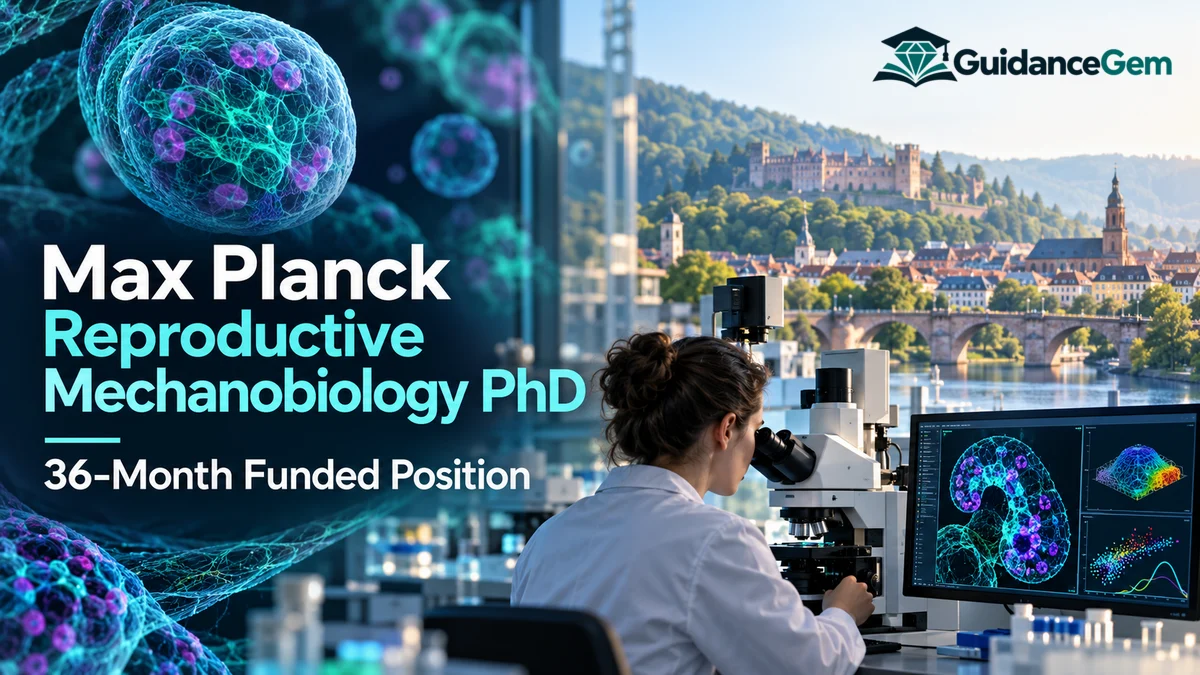
The Max Planck Reproductive Mechanobiology PhD is a funded doctoral position in Heidelberg, Germany. It investigates the mechanics of the female reproductive tract. The Max Planck Institute for Medical Research offers an initial three-year contract under the ERC REPROMECH project.
Applications close on 1 November 2026. The position is paid at 75% of the TVöD Bund E13 scale. Applicants need a related master’s qualification and must be willing to work with laboratory mice under the project’s animal-research arrangements.
Max Planck Reproductive Mechanobiology PhD Details
Dr Stephanie Möllmert’s research programme links reproductive biology with mechanics and quantitative experimentation. Methods include microscopy, ex vivo tissue culture, histology and image analysis. The project therefore needs both careful laboratory work and quantitative interpretation.
The planned start is 1 January 2027 or as soon as possible afterward. Extension may be possible, but the initial contractual period is three years. Research fit should address the actual biological and experimental questions, rather than a general interest in Max Planck.
Programme / award | Max Planck Reproductive Mechanobiology PhD |
|---|---|
Location | Heidelberg, Germany |
Level / route | Doctoral research employment |
Duration | Initially three years; start 1 January 2027 or soon after |
Verified support | 75% TVöD Bund E13 doctoral contract |
Deadline | 1 November 2026 |
Stay Updated with Guidance Gem
Follow Guidance Gem for scholarship and career updates. Check each opportunity’s official source before applying.
Use the channels below to receive new guides and application reminders.
Max Planck Reproductive Mechanobiology PhD Benefits
The official offer specifies 75% TVöD Bund E13 remuneration. It does not publish a universal net salary or take-home euro amount. The eventual employment offer controls the applicable pay and personal deductions.
The position is supported through the ERC-funded REPROMECH project. Doctoral work combines microscopy and tissue experiments with quantitative data analysis. An extension is described as possible rather than guaranteed.
For a separate funded doctoral project in Germany, compare Max Planck Great Apes PhD 2027. Its subject, nationality rules and funding conditions differ from this award.
Max Planck Reproductive Mechanobiology PhD Eligibility
Applicants need a master’s degree in biology, biophysics, physics, bioengineering or a related area. Experimental aptitude and quantitative skills are central to the profile. Excellent English is required for scientific communication.
Willingness to work with laboratory mice is an essential condition. Prior reproductive-biology, microscopy, biophysics or animal-research experience is advantageous, but not stated as compulsory. The institute provides relevant animal-work training.
A different experimental research route is described in IMPRS CPQM PhD Positions 2027. Compare its current conditions before choosing an application route.
Requirements and Documents
The portal requires academic and application evidence tailored to this vacancy. Your cover letter should connect previous methods and research interests to reproductive mechanobiology. Claims about animal or microscopy experience should reflect work you actually performed.
The official checklist includes contacts for two academic referees. Ask those people before listing them. Upload degree and transcript records in the format requested by the application portal.
How to Apply
Apply through the recruitment route linked from the official Max Planck vacancy. The advertised job code is 23/2026. Check the institute, project and code before submitting to avoid choosing another doctoral role. Read the official application instructions.
Dr Stephanie Möllmert is the named scientific contact. Use the official vacancy’s contact details for substantive project questions. The application itself must follow the published recruitment process.
Application Deadline
Applications close on 1 November 2026. The post is vacancy 23/2026, and the contract is expected to start on 1 January 2027 or as soon as possible afterwards. The listing states no closing hour or time zone, so submit early.
Applicants submit a cover letter, CV, degree certificates, transcripts and two academic referee contacts through the electronic portal. Contact details for questions are listed on the vacancy page. Check the vacancy page for later changes.
For another doctoral funding model and subject area, see Jülich Operando X-ray PhD. Treat its funding and application conditions as independent.
Frequently Asked Questions
These answers cover the contract, eligibility and application questions about this Max Planck PhD vacancy. They follow the official vacancy notice.
Where the notice states a requirement, such as willingness to work with laboratory mice, the answer says so. Check the vacancy page before you submit.
How long is the initial contract?
Three years, with an extension described as possible.
What salary is confirmed?
The official offer is 75% TVöD Bund E13; it does not give one fixed take-home euro amount.
Is work with mice optional?
No. Willingness to work with laboratory mice is part of the profile.
Is previous animal experience compulsory?
Prior experience is advantageous, while relevant training is provided.
Which methods are involved?
The listing includes microscopy, ex vivo tissue culture, histology, and quantitative image and data analysis.
How many referees are requested?
Contacts for two academic referees are required.
Conclusion
The Max Planck Reproductive Mechanobiology PhD is a paid research role focused on reproductive-tract mechanics. Its initial three-year contract uses 75% of TVöD Bund E13, rather than a standalone scholarship amount. Applicants should assess both the quantitative laboratory work and the requirement to work with mice.
Use your application to demonstrate preparation for microscopy, tissue experiments and image analysis relevant to the project. Check the vacancy’s document instructions and explain your research fit clearly. Submit by 1 November 2026 for the planned January start or agreed later date.

